 Kilby
Kilby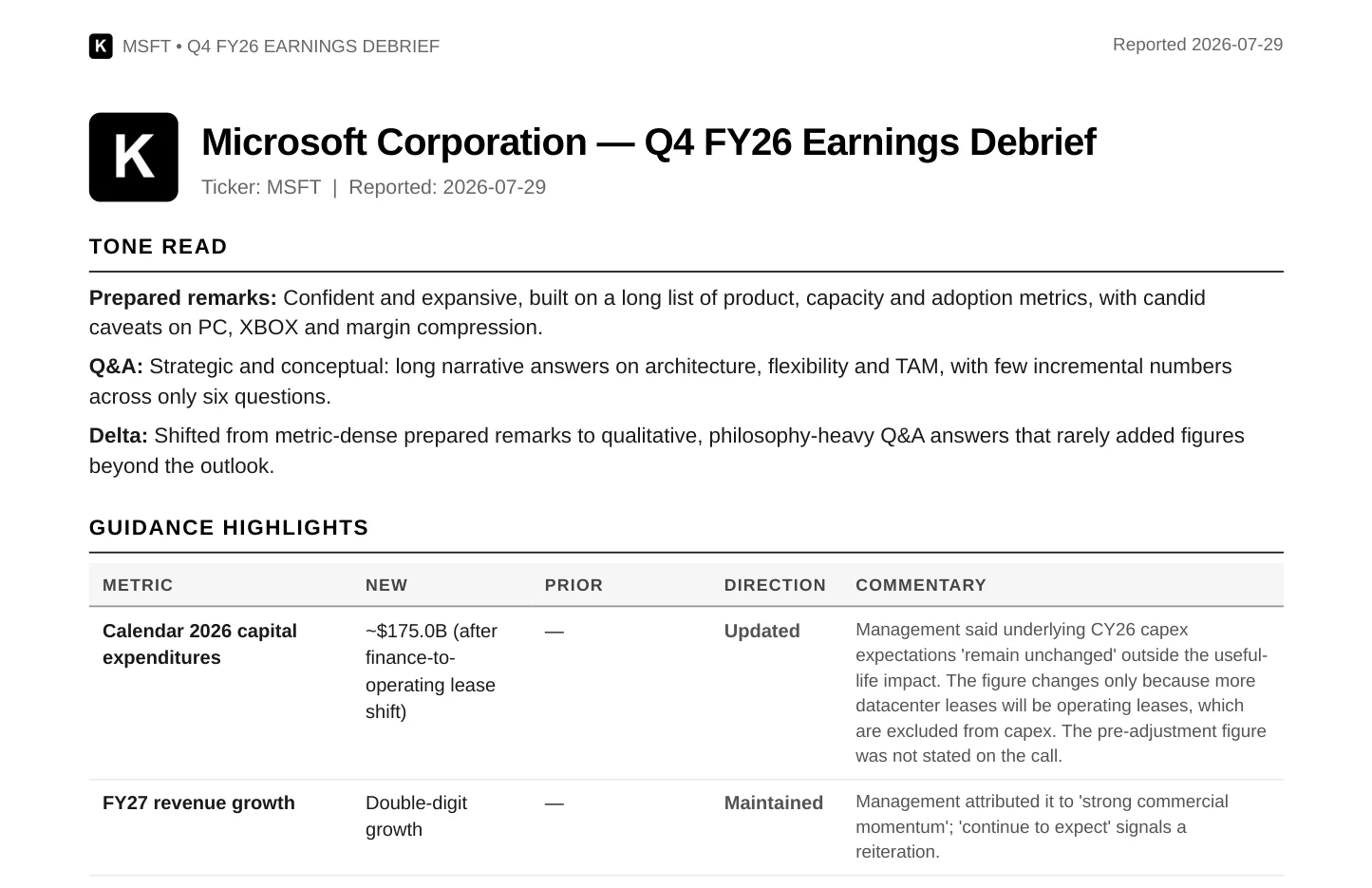
Earnings/debrief
Attach an earnings call transcript and get a debrief of the call.
- Tone of the prepared remarks and the Q&A
- Guidance: new, changed and maintained
- Bull and bear signals, deflections and follow-up questions
PDF report
Kilby combines market intelligence, financial data and the information you give it to deliver institutional-grade analysis. Kilby thinks in micro and macro terms, works around the clock, and fits into your team like a seasoned colleague.
Kilby analyzes and summarizes your past chats and folders, overlays real-time information, and gives you its current take.
Kilby reads your holdings, price targets and theses, so answers are informed by this context.
Kilby draws figures from company filings so you don't have to.
Watchlist
Keep your holdings, weights, price targets and theses current: upload a new list whenever they change, or edit a price target or thesis right in Kilby. Kilby remembers all of it when you ask a question or set an alert, and proactively points out what to watch for and where you may have outsized risk or opportunity. The 3D View shows every sector's weight and how far each name sits from its price target.
Everyone on the team sees the same holdings list with the same information. Kilby leverages this information in order to provide context-aware responses.
Each sector is a tower and each holding a block, sized by its weight and colored by its distance to its price target.
Investors
In addition to Kilby's context-aware chat, here are three powerful tools for investors
Attach an earnings call transcript and get a debrief of the call.
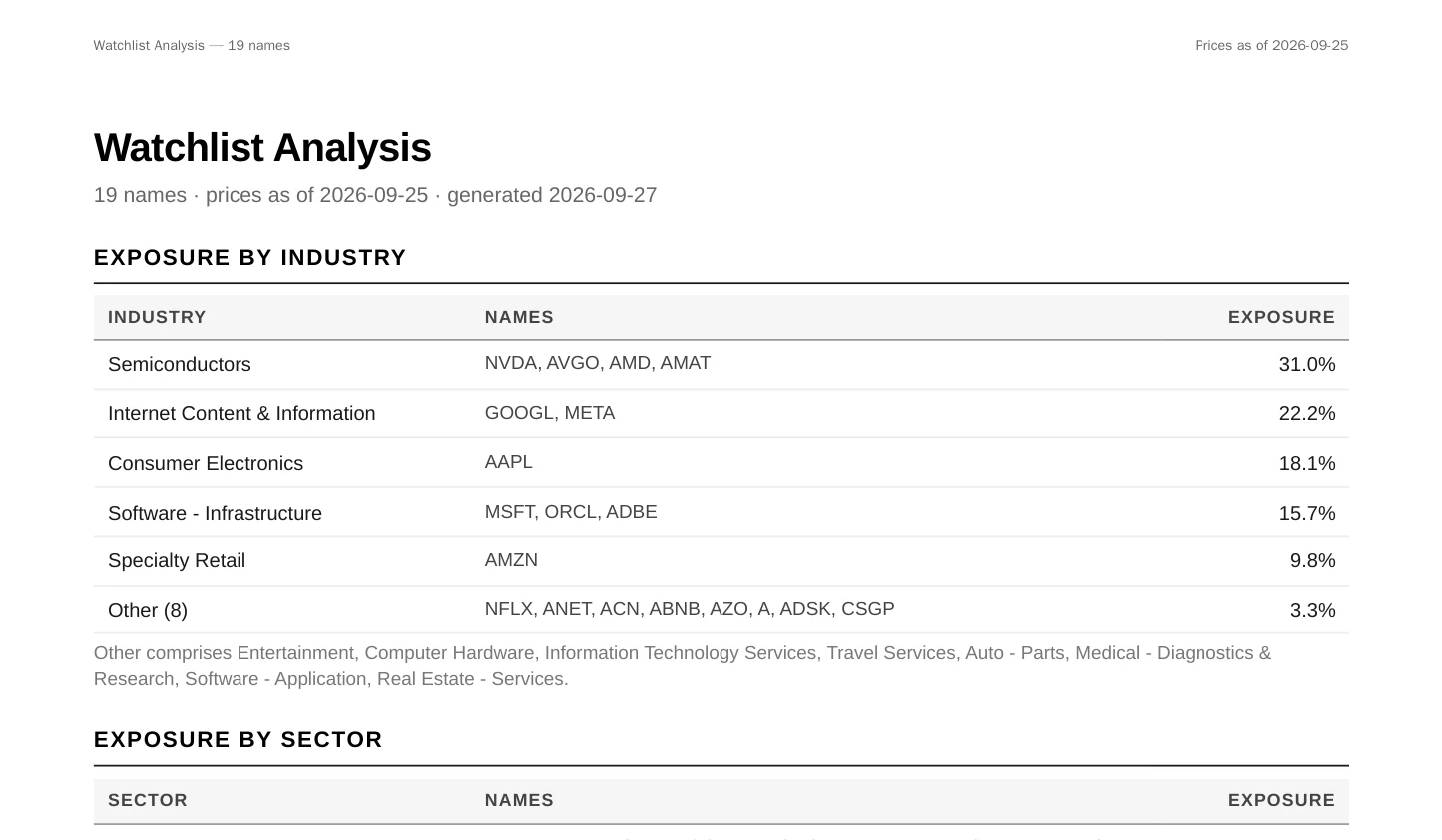
A report on every name on your watchlist.
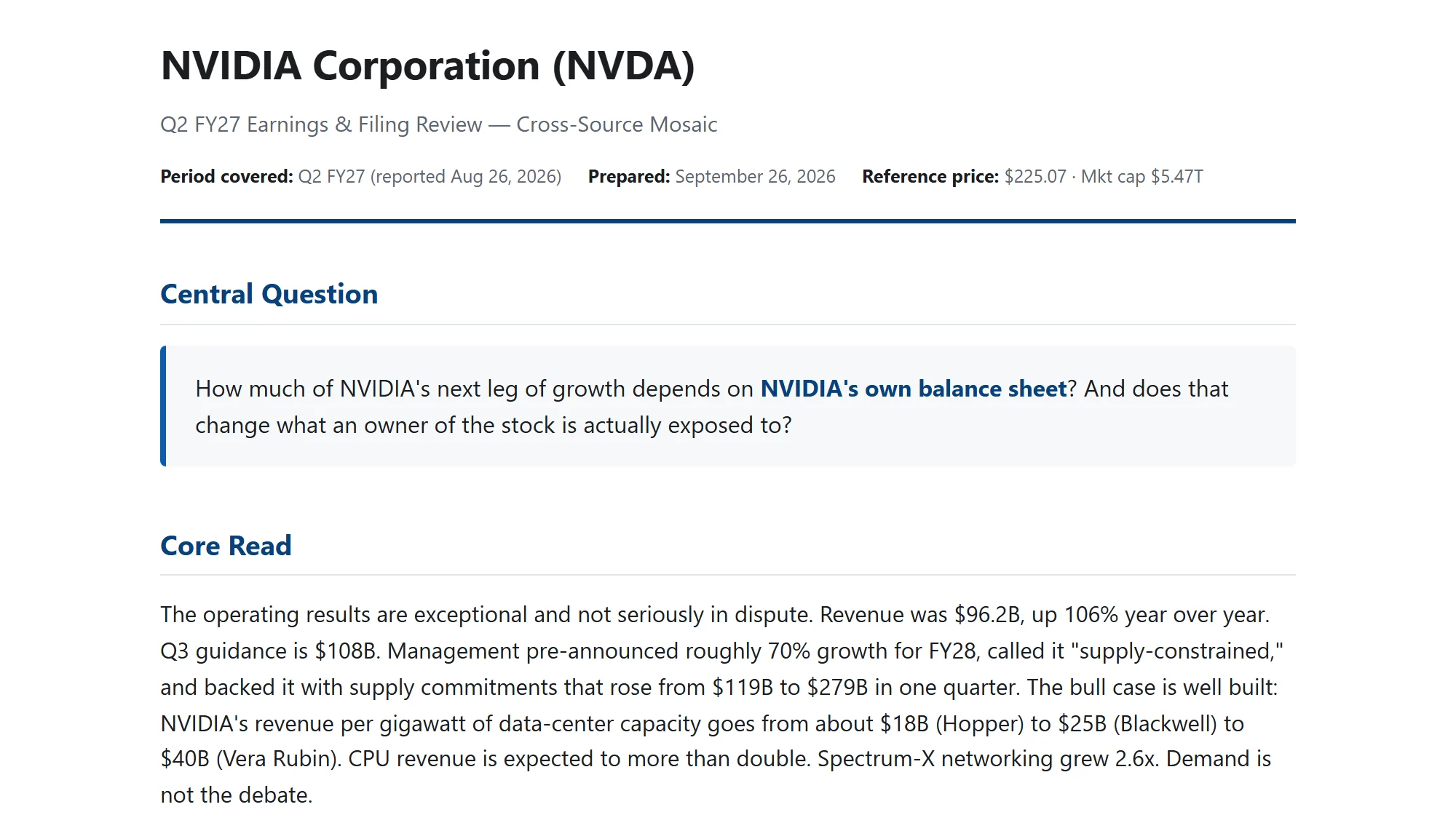
Attach anything on a company and get one cohesive view.
Context
Your investment process or operating style, and how you use Kilby. Defined in Settings.
For investors: each holding's weight, price target and thesis. Keep them current; Kilby works from the latest.
Alerts
SEC filings, company news and macro, each item dated and linked, and what it means for your portfolio.
Set a level on any name, and Kilby tells you when it is crossed.
Operating executives
180+ decision frameworks, drawn from the documented practices of 19 people who ran the companies.
Andy Grove Intel · Warren Buffett Berkshire Hathaway · Charlie Munger Berkshire Hathaway · Jeff Bezos Amazon · Steve Jobs Apple · Jamie Dimon JPMorgan Chase · Ray Dalio Bridgewater · Stanley Druckenmiller Duquesne · John Malone Liberty Media · Jensen Huang NVIDIA · Ben Horowitz a16z · Bill Gurley Benchmark · Howard Schultz Starbucks · T.J. Rodgers Cypress Semiconductor · Sam Walton Walmart · Bill Campbell Intuit · Patrick Collison Stripe · Bill McDermott ServiceNow · Pavel Durov Telegram
Frameworks surface on their own when the question calls for them, attributed to the leader they came from. Where leaders disagree, both views are shown.
Experience Lenses
Kilby changes what it prioritizes, what it questions and how it frames the output. A portfolio manager and a compliance officer do not get the same answer to the same question.
Allocation-minded, downside-aware, and valuation-disciplined.
Frames decisions through sizing, risk, portfolio fit, time horizon, and valuation rather than just whether an idea sounds good.
Connections
Kilby is optimized for investment research, yet its capabilities extend far beyond that vertical. Ask Kilby anything. Connect it to Google Workspace and Slack to automate your workflows.

Calendar, Contacts, Drive, and Photos

Read and post messages in connected channels
Pricing
Buy a credit pack. Credits are drawn down as you use Kilby. No recurring charge; top up when you need more.
Kilby chooses the model for each task, so you are never picking an engine.